Introduction
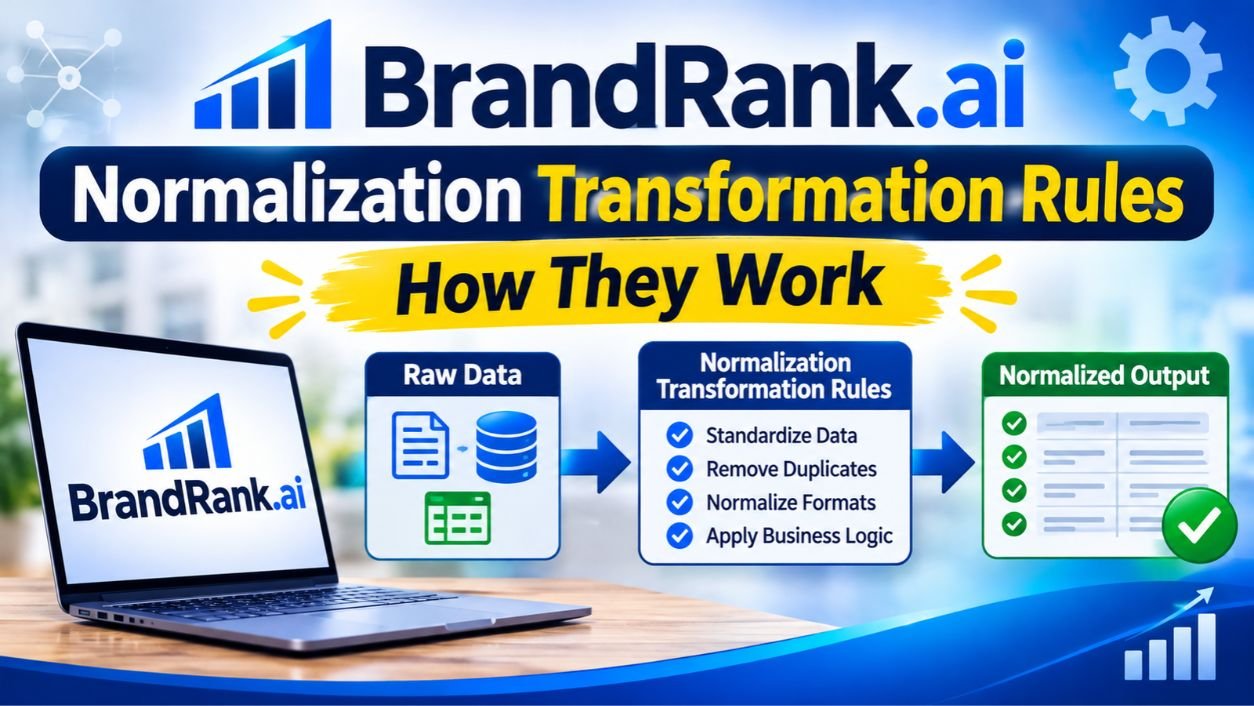
BrandRank.ai normalization transformation rules relate to how brand names, products, and company identities are organized for AI brand visibility analysis. Understanding these concepts helps businesses maintain consistent brand information, reduce duplicate records, and analyze AI-generated recommendations more accurately.
BrandRank.AI’s published research methodology includes a normalization stage that groups product names by product family and brand references by parent company or brand, depending on the measurement. Understanding this process can help marketing teams make better decisions about AI search visibility.
What Is BrandRank.ai Normalization Transformation?
Brand normalization is the process of identifying and organizing different references to the same brand or related products. Data transformation involves converting information into consistent formats that make it easier to process and analyze.
For example, a company might appear online as “ABC Technologies,” “ABC Tech,” and “ABC Technologies Inc.” A verified normalization process can connect these variations to one official company identity.
Transformation rules can also standardize product categories, website information, dates, and other business data.
| Normalization | Transformation |
|---|---|
| Standardizes related identities | Changes data formats or structures |
| Identifies duplicate records | Prepares information for analysis |
| Groups related brands and products | Applies defined processing rules |
| Improves entity consistency | Supports consistent reporting |
These processes work together to make brand information easier to understand and manage.
How BrandRank.ai’s Normalization Methodology Works
BrandRank.AI documents a four-stage research methodology: Ask, Answer, Normalize, and Check. Each stage contributes to a more structured approach to analyzing AI-generated brand recommendations.
- Ask: Researchers submit relevant questions to AI platforms to examine how brands appear in responses.
- Answer: They collect AI-generated answers and identify brand mentions, products, and recommendations.
- Normalize: Brand references are grouped by product family or parent company, depending on the research objective.
- Check: Results are reviewed for accuracy, relevance, and incorrect brand identification.
This methodology helps distinguish product-level recommendations from broader company-level visibility.
For example, a recommendation for one software product should not automatically be counted as a recommendation for every product owned by its parent company.
Reference: BrandRank.AI Research Hub
Key Normalization Transformation Rules for Brand Data
Businesses can apply several general data management practices to maintain consistent brand information. These are practical recommendations, not a verified list of proprietary BrandRank.AI software rules.
1. Brand Name Standardization
Use verified official brand names and maintain approved variations or aliases. For example, “Microsoft Corporation” and “Microsoft” may refer to the same organization, depending on the context.
2. Product and Parent-Company Mapping
Connect products with their correct brands and parent companies. Keep individual product identities separate when analyzing product-level recommendations.
3. Domain and Website Matching
Identify websites belonging to the same organization while preserving their individual purposes. A business may operate separate domains for different countries, products, or services.
4. Duplicate Removal and Entity Resolution
Check whether different records represent the same company or product before merging them. Useful verification signals include official websites, business information, and product ownership.
5. Consistent Data Formatting
Apply standard formats for dates, categories, company identifiers, and other information. Consistency makes records easier to compare across different systems.
Practical Example of Brand Data Normalization
Imagine a fictional software company called NovaTech. Its information appears across several websites and AI-generated answers.
Before normalization, its records might include:
- NovaTech Inc.
- NovaTech
- Nova Tech
- NovaCRM
- NovaMail
Without proper organization, these references could be incorrectly counted as separate businesses.
After verification, the marketing team can create one central company record for NovaTech Inc. and connect NovaCRM and NovaMail as individual products.
This allows the team to measure product-level recommendations separately while also analyzing relevant company-level mentions.
The original references should remain available for verification and auditing. This prevents useful information from being lost during the normalization process.
Why Normalization Matters for AI Brand Visibility
Consistent brand information supports more reliable AI visibility analysis. It helps businesses understand how their names and products appear in AI-generated responses.
Key benefits include:
- Consistent brand monitoring: Connect different references to the correct brand identity.
- Better competitor comparisons: Compare companies and products using clearly defined categories.
- More reliable reporting: Reduce duplicate records and incorrect classifications.
- Improved data management: Maintain accurate brand, product, and ownership information.
- Clearer recommendation analysis: Distinguish product mentions from parent-company recommendations.
However, normalization does not guarantee better AI rankings, citations, or recommendations. It improves the quality of the information used for analysis rather than controlling how AI platforms generate answers.
How Businesses Can Apply Brand Data Normalization
Businesses can improve brand data consistency by following a simple process:
- Collect brand information: Gather company names, product details, website domains, and existing brand mentions.
- Verify official identities: Identify the correct company names and approved aliases.
- Map products and brands: Connect products with their correct brands and parent companies.
- Create transformation rules: Establish consistent naming, formatting, and categorization standards.
- Check duplicate records: Identify incorrect matches and remove confirmed duplicates.
- Preserve original information: Keep source records so changes can be reviewed and corrected.
- Update records regularly: Review information after rebranding, acquisitions, and product launches.
A documented process helps marketing teams maintain consistent information across their digital platforms.
Common Normalization Mistakes to Avoid
Even small data management mistakes can affect brand visibility reports. Businesses should avoid these common problems:
- Merging similar names without verification: Similar company names do not always represent the same organization.
- Confusing products with companies: A product recommendation is not automatically a parent-company recommendation.
- Deleting original records: Always preserve source information for auditing.
- Using inconsistent rules: Different departments should follow the same documented standards.
- Ignoring business changes: Update records when companies rebrand, acquire businesses, or introduce new products.
- Expecting guaranteed AI visibility: Normalization improves data consistency but does not guarantee better AI recommendations.
Best Practices for Maintaining Accurate Brand Data
For long-term accuracy, businesses should maintain a central brand identity database containing official names, aliases, product relationships, and website information.
They should also document every transformation rule, use reliable sources for verification, and maintain an audit trail of changes.
Regular reviews are equally important. Accurate brand information makes it easier to monitor AI-generated recommendations and compare performance over time.
More Post: Droven.io AI in Digital Transformation: A Business Guide
FAQs
1. What are BrandRank.ai normalization transformation rules?
They refer to concepts involving the standardization and organization of brand information for AI visibility analysis. BrandRank.AI’s published methodology includes grouping product names by product family and brand references by parent company or brand.
2. How does BrandRank.ai normalize brand information?
BrandRank.AI documents a four-stage methodology: Ask, Answer, Normalize, and Check. Its normalization stage organizes brand and product references according to the purpose of the analysis.
3. What is the difference between normalization and transformation?
Normalization focuses on making related information consistent and identifying duplicate identities. Transformation changes information into a structured format suitable for processing, reporting, or analysis.
4. Why is brand normalization important for AI search visibility?
It helps businesses identify different references to the same brand and organize AI-generated mentions consistently. This supports clearer brand monitoring and competitor comparisons.
5. Can brand normalization improve AI recommendations?
Normalization can improve data quality and the reliability of visibility analysis, but it cannot guarantee better AI recommendations. AI platforms use their own systems to generate answers.
6. How often should businesses update brand normalization rules?
Businesses should review their rules regularly, particularly after rebranding, acquisitions, new product launches, and website changes. Regular updates help prevent outdated information from affecting reporting.